Las Terrenas vs Punta Cana: Which Dominican Paradise Is Right for You?
The Dominican Republic is one destination with many faces. Ask ten travelers where they went and you will likely hear two answers above all others: Punta Cana and Las Terrenas. They share a country, a language, and a coastline. Beyond that, they are almost entirely different experiences — different in scale, in culture, in cuisine, in atmosphere, and in the kind of traveler each place genuinely suits.
If you are planning a luxury escape to the Caribbean and trying to decide between the two, this guide cuts through the noise. No vague praise for either side. Just an honest, specific comparison that helps you spend your time and money in exactly the right place.
The Core Difference: Resort Machine vs Authentic Caribbean Village
Punta Cana is built around the all-inclusive resort complex. The eastern tip of the DR has been engineered over the past four decades into one of the highest-capacity tourism infrastructures in the Caribbean. The beaches are beautiful — Bávaro Beach is legitimately stunning — but the experience surrounding those beaches has been packaged, branded, and replicated across dozens of mega-resorts that line the coast. You will share the sand with thousands of other guests. You will eat buffet meals in air-conditioned dining halls. You will be shuttled between your resort and the airport on a motorcoach with sixty strangers.
None of that is a criticism if mass tourism is what you are after. Punta Cana delivers its product with ruthless efficiency. But if you came to the Caribbean to actually experience the Caribbean — its food, its culture, its pace, its people — the all-inclusive bubble is specifically designed to keep that experience at arm's length.
Las Terrenas, on the north coast of the Samaná Peninsula, operates on an entirely different logic. There are no mega-resorts here. There are no cruise ship terminals. There is no strip of identical swim-up bars. What you find instead is a small, cosmopolitan town shaped by decades of French and Italian expat settlement woven together with Dominican Caribbean culture — a combination that exists nowhere else in the country and almost nowhere else in the region.
The Beaches: Manicured vs Magnificent
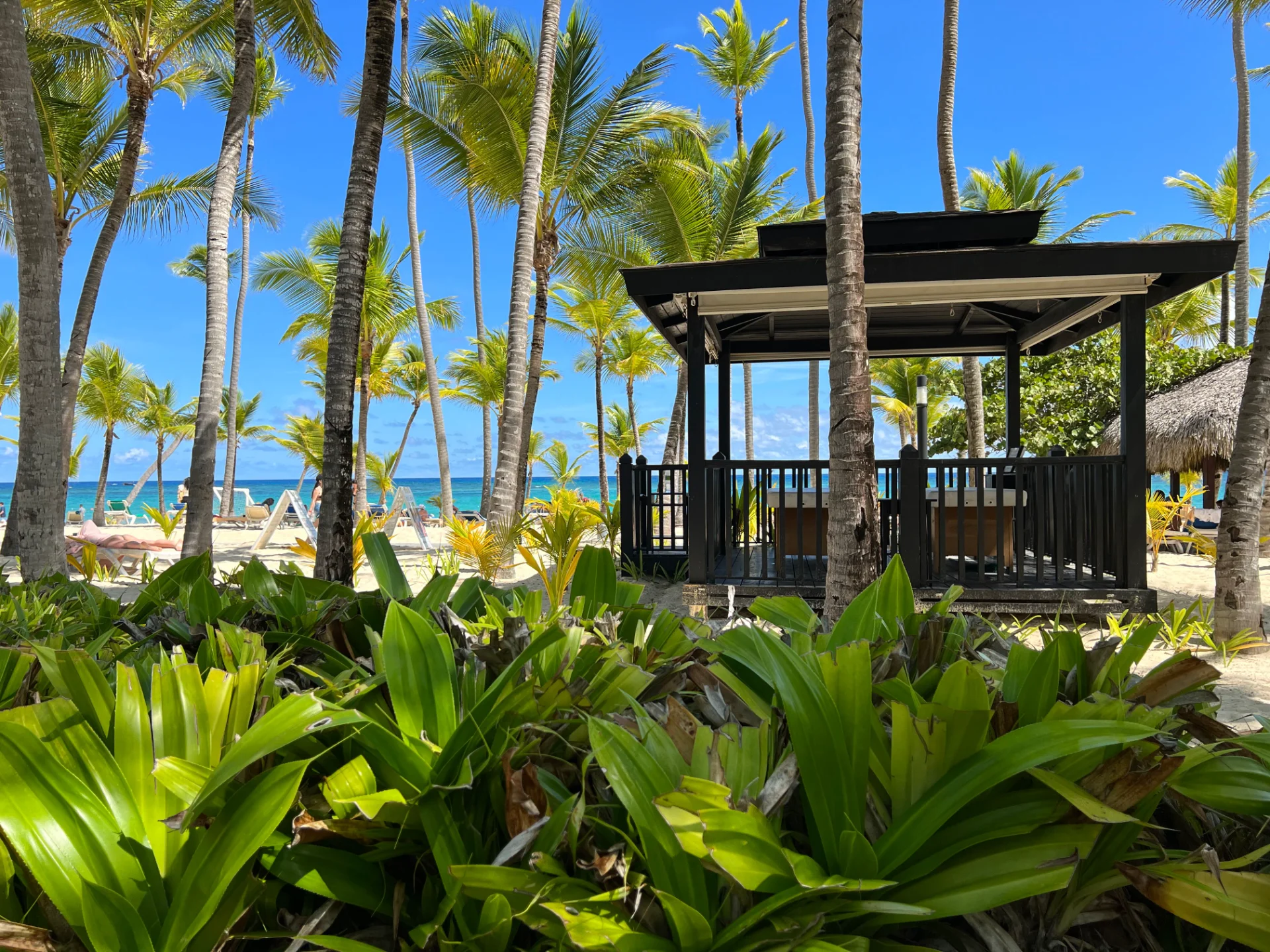
Punta Cana's beaches are undeniably photogenic. The palm-lined stretch of Bávaro is wide, the sand is pale, and the water is calm. But those same beaches are lined with resort loungers, staffed by vendors circling every ten minutes, and shared with a guest population that can number in the tens of thousands on any given week.
Las Terrenas tells a different story. Playa Las Ballenas sits just minutes from the town center and offers a relaxed stretch of sand bordered by fishing boats and backed by a handful of low-key beach bars. Playa Cosón, a 20-minute drive west, has been cited repeatedly as one of the finest beaches in the entire Caribbean — a two-kilometer arc of near-empty white sand where the Atlantic meets the Caribbean with almost no infrastructure in sight. On a Tuesday morning in February, you may share it with a dozen people.
Playa El Portillo, to the east, is the base for kitesurfing and windsurfing — one of the best sites for both sports in the DR. And Playa Rincón, roughly 45 minutes from Las Terrenas, is the kind of beach that stops conversations. Accessible only by boat or a rough road, it remains one of the most pristine beaches in the Dominican Republic, backed by a palm forest and fronted by water in five shades of blue.
For the luxury traveler who values beauty without the crowd, this comparison is not particularly close.
Food and Nightlife: Buffet vs Bistro
This is where Las Terrenas wins with particular authority. The town punches far above its weight gastronomically — a legacy of its European expat community and its access to exceptional local seafood.
Le Bistrot de Pierre is the kind of French restaurant that would hold its own in Lyon. El Pescador is the place locals take visiting family when they want to make an impression — grilled fish, cold beer, the sound of waves. Ocho Locos brings energy and flavor to a relaxed Caribbean setting. Café de Paris has been serving espresso and croissants to a mixed Franco-Dominican crowd for longer than most tourists have been visiting the town. La Hermita, perched on a hillside, delivers both a serious kitchen and a view to match.
Punta Cana has made significant investments in its dining scene over the past decade, and the upscale restaurants within the resort corridors have improved considerably. But the structural reality of the all-inclusive model is that most guests never leave the property — which means most of Punta Cana's food infrastructure serves mass volume rather than culinary ambition.
In Las Terrenas, dinner is an event. You walk to a restaurant, you sit next to people from Paris and Milan and Santo Domingo, you order fresh-caught mahi-mahi or a proper French onion soup, and you take the long way home along the beach. That experience is not available at an all-inclusive resort at any price point.
Activities: Organized Excursions vs Genuine Adventure
Both destinations offer the full catalog of Caribbean activities: snorkeling, scuba diving, boat trips, ATV tours, and horseback riding. The difference is context and access.
In Punta Cana, most activities are sold through resort concierge desks and executed on group excursion schedules. You are never far from a tour operator with a clipboard.
In Las Terrenas and across the Samaná Peninsula, the activities are embedded in the landscape itself. Between January and March, Samaná Bay — roughly 30 minutes from Las Terrenas — hosts one of the largest humpback whale migration events in the North Atlantic. Thousands of whales pass through these waters each winter, and the whale-watching excursions here are among the most extraordinary wildlife experiences available anywhere in the Caribbean. Punta Cana offers no equivalent.
The peninsula's interior is covered in hills and tropical forest, making ATV rides and horseback excursions genuinely exploratory rather than staged. The kitesurfing and windsurfing conditions at Playa El Portillo attract serious athletes from Europe and North America. Scuba diving off the peninsula accesses wall dives and reef systems with significantly less boat traffic than the dive sites around Punta Cana.
For travelers who want to do things rather than simply be transported through them, the Samaná Peninsula offers a more vivid and memorable program.
Getting There: Convenience vs Reward
This is the one category where Punta Cana has a meaningful structural advantage. Punta Cana International Airport (PUJ) is one of the busiest airports in the Caribbean, with direct connections from dozens of cities across North America, Europe, and Latin America. You land, you clear customs, you board your resort bus. Forty-five minutes later you are at the swim-up bar.
Las Terrenas is served by El Catey International Airport (AZS), which handles regular commercial flights from several major hubs including New York-JFK, Miami, Montreal, and Paris. The drive from El Catey to Las Terrenas takes approximately 90 minutes and winds through the extraordinary scenery of the Samaná Peninsula — a drive that many guests describe as one of the highlights of the journey.
For travelers connecting through Santo Domingo, a private transfer from Las Américas International Airport (SDQ) takes roughly 2 hours. It is not a complicated journey. It simply requires a modestly higher tolerance for travel than stepping onto a resort shuttle — a tolerance that most luxury travelers possess, and that is rewarded handsomely on arrival.
Accommodation: Volume vs Villa
Punta Cana's accommodation landscape is dominated by large resort chains. The quality at the upper end — Aman, Eden Roc, Tortuga Bay — is genuinely excellent and genuinely expensive. But the default experience is a large resort room within a large resort complex, and the privacy and intimacy available within that format has natural limits.
Las Terrenas offers something the all-inclusive model structurally cannot: a private villa with panoramic views, a pool that belongs entirely to you, and no other guests anywhere in sight.
Villa Paris is a three-bedroom luxury villa set on an elevated hillside above Las Terrenas, with 180-degree panoramic views of the Caribbean Sea and the mountains of the Samaná Peninsula from every outdoor space. The private infinity pool faces the ocean. The three en-suite bedrooms accommodate up to eight guests. There is a full chef's kitchen and an outdoor dining terrace where you can serve a proper dinner under the stars with the sea laid out below you.
Rates start from $219 per night direct — which, divided across eight guests, positions Villa Paris not just as the more authentic choice but as the more economical one. Bookings are made directly at stayvillaparis.com/book, and the team is reachable on WhatsApp at +1 (829) 613-0294 or by email at hello@villaparis.com.
The contrast with a Punta Cana resort is stark. At Villa Paris, you wake up when you choose, swim in a pool that is yours alone, drive ten minutes to a nearly empty beach, and eat dinner at a French restaurant where the chef grew up in Brittany. That experience is simply not available in the eastern corridor, regardless of your budget.
Who Each Destination Actually Suits
Punta Cana suits travelers who want convenience above everything else: fast access, predictable amenities, minimal planning, and the comfort of knowing exactly what they are getting. It is genuinely excellent for large families with young children who need structure, for corporate groups that require conference facilities, and for first-time Caribbean visitors who prefer the security of a managed resort environment.
Las Terrenas suits travelers who want to actually be somewhere. Couples celebrating anniversaries or honeymoons. Groups of friends who want their own villa, their own pool, and the freedom to discover a place rather than consume a product. Travelers who have done Punta Cana and are ready for something with more texture. Travelers who read restaurant reviews before they book a vacation. Anyone who has ever looked at a resort wristband and felt vaguely defeated.
The Verdict on Las Terrenas vs Punta Cana
This comparison between Las Terrenas and Punta Cana ultimately comes down to a single question: do you want a Caribbean holiday, or do you want the Caribbean?
Punta Cana delivers a polished, efficient, and perfectly pleasant version of the former. Las Terrenas — with its extraordinary beaches, its European-influenced food culture, its whale-watching season, its hillside villas with infinity pools and panoramic sea views — delivers something much closer to the latter.
For travelers who have arrived at this article because they are genuinely choosing between the two, the fact that you are weighing the options at all suggests you are the kind of traveler Las Terrenas was made for.
Villa Paris is waiting for you on that hillside, with the sea stretched out below it and three en-suite bedrooms ready to be filled. Explore the property at stayvillaparis.com, check availability at stayvillaparis.com/book, or reach the team directly on WhatsApp at +1 (829) 613-0294.
Frequently Asked Questions
Is Las Terrenas better than Punta Cana for a luxury vacation?
For travelers who prioritize authenticity, privacy, and a genuine cultural experience, Las Terrenas is the stronger choice. It offers world-class beaches like Playa Cosón, excellent French and Mediterranean-influenced dining, whale watching from January through March, and private villa accommodations like Villa Paris that offer panoramic Caribbean Sea views, a private infinity pool, and full concierge-level service from $219 per night. Punta Cana excels in convenience and all-inclusive resort infrastructure, but cannot match the intimacy or character of the Samaná Peninsula.
How far is Las Terrenas from the airport?
Las Terrenas is approximately 40 minutes from El Catey International Airport (AZS), which receives direct flights from New York-JFK, Miami, Montreal, Paris, and other hubs. Travelers connecting through Santo Domingo's Las Américas Airport (SDQ) should plan for approximately 2.5 hours by private transfer. The drive through the Samaná Peninsula is genuinely scenic and widely considered a pleasant introduction to the region rather than an inconvenience.
What is the best time of year to visit Las Terrenas?
Las Terrenas is a year-round destination, but December through April offers the driest and most reliably sunny weather — making it the peak season. January through March is particularly special because Samaná Bay, just 30 minutes away, hosts one of the largest humpback whale migrations in the North Atlantic. Whale-watching during this period is one of the most extraordinary wildlife experiences in the Caribbean. Shoulder season from May to November can offer quieter beaches and lower rates, with occasional tropical rain that rarely lasts more than an afternoon.
Are there good restaurants in Las Terrenas?
Las Terrenas has an exceptional dining scene by any Caribbean standard, shaped by decades of French and Italian expat settlement. Standout restaurants include Le Bistrot de Pierre for classic French cuisine, El Pescador for fresh seafood, Ocho Locos for a lively Caribbean atmosphere, Café de Paris for breakfast and espresso, and La Hermita for hilltop dining with views. The quality and variety available in a town of this size is genuinely unusual and represents one of the strongest arguments for choosing Las Terrenas over a resort destination where dining options are largely controlled by a single hotel group.
How many guests can Villa Paris accommodate, and what is the nightly rate?
Villa Paris accommodates up to 8 guests across three fully en-suite bedrooms, making it ideal for families, friend groups, or couples traveling together who want their own private space rather than adjacent resort rooms. The villa features a private infinity pool with panoramic Caribbean Sea views, a full chef's kitchen, an outdoor dining terrace, and elevated hillside positioning that provides 180-degree views of the sea and the Samaná mountains. Rates start from $219 per night when booked directly at stayvillaparis.com/book. The team is available via WhatsApp at +1 (829) 613-0294 or by email at hello@villaparis.com.
Las Terrenas · Dominican Republic
Stay at Villa Paris
Private infinity pool · Panoramic sea views · 3 bedrooms · From $199/night
Book Direct